
UK Rail Commute Note-Taking: Making the Most of Your Journey
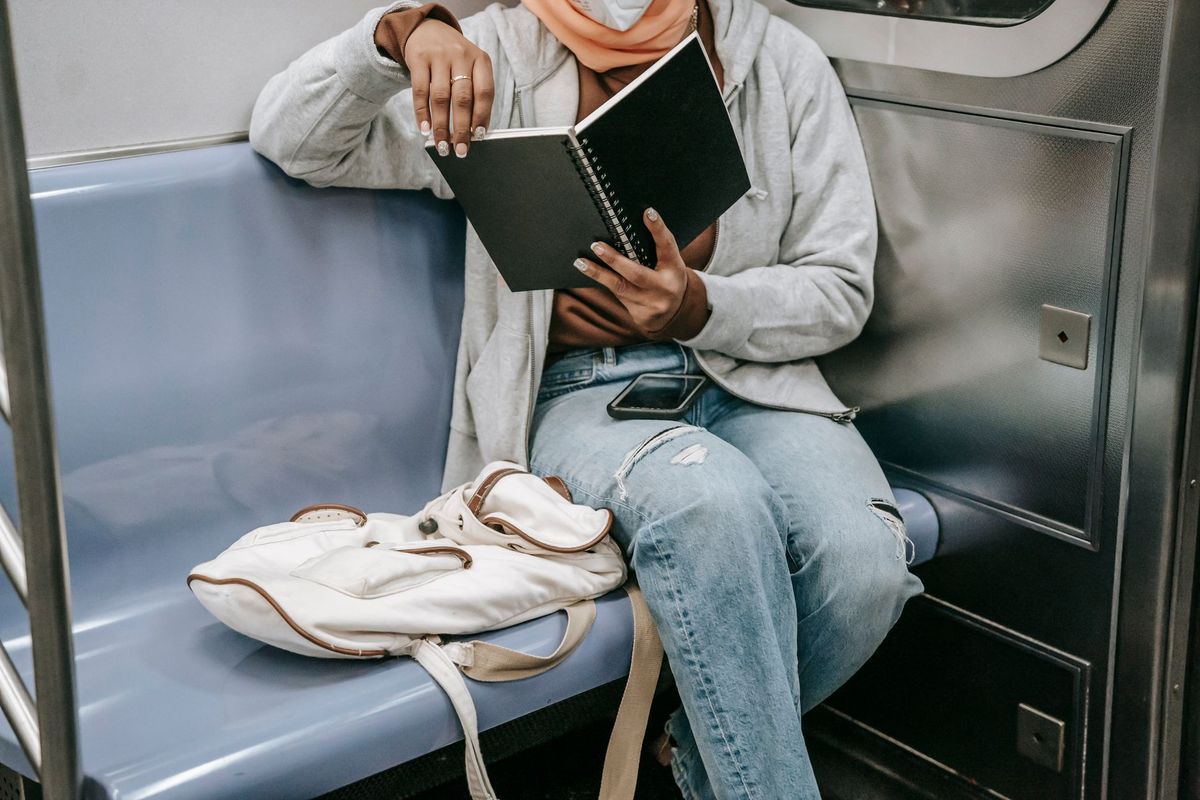
Most commuters treat the train as a gap between two real parts of the day: ninety minutes of scrolling, a cooling coffee, then the desk. It is worth looking at the same journey differently. A carriage is one of the few places where nobody can ask you a question, the door is shut, and there is nothing to tidy. That makes it unusually good for thinking on paper, or on a screen, as long as you decide in advance what you are there to do.
The train gives you something a desk cannot
Bounded time is the main gift. You know the journey ends at 08:14, and that deadline concentrates the mind better than any app. There are no colleagues at your shoulder and no laundry in the corner. The constraints help too: a narrow tray table, handwriting that wobbles over the points, a signal that vanishes for ten minutes at a time. When you cannot open twelve tabs, you tend to finish one thought rather than start another.
Plan for the ordinary journey rather than the ideal one. Trains run late, table seats go first, and the person beside you may be on a very loud call about a spreadsheet. A method that only works in a quiet carriage with a table and a charged laptop is not a method; it is a hope.
Choose one job for the journey
Three things are worth doing with train time, and they do not mix well.
- Capture. Getting loose ideas, observations and tasks out of your head and into one place. Best done early, before you are awake enough to start editing yourself.
- Review. Reading back through notes you already have, deciding what still matters and what can go. Needs a seat, a pen and a little quiet.
- Plan. Turning what you have collected into a short, realistic list for the day. Best in the last fifteen minutes, so the plan is fresh when you arrive.
Trying to do all three in one trip usually produces a half-finished list, three unread pages and no plan worth following. Pick one job per journey and rotate it across the week. Capture on Monday and Tuesday. Review on Wednesday. Plan on Thursday. Leave Friday for whatever is loudest, or for reading something with nothing to do with work.
Capturing without losing the thread
If the journey is for emptying your head, speed matters more than neatness. A few rules keep a capture session useful:
- One idea per line. Two ideas on one line become one idea by the time you read them back.
- Write the trigger alongside the thought. "Ask about the Friday deadline" means little a week later; "ask about the Friday deadline — mentioned on the walk to the station" gives it a home.
- Date the page. Not for the archive, but for the review session that follows.
- Do not organise while capturing. Sorting, tagging and filing are separate jobs, and doing them at the same time is how an idea gets lost between categories.
- Stop when the flow stops. Ten captured minutes beat forty minutes of staring out of the window, and the window is not a failure.
If you would rather speak than write
A voice memo is often faster than typing with one thumb on a moving train. Keep memos under a minute, say the action as well as the idea, and save them somewhere you will revisit — a folder called "train notes" is enough. If you feel self-conscious talking in a quiet coach, speak softly into the microphone. Most people around you are wearing headphones anyway.
Reviewing notes on the move
Review is the part most people skip, and the train suits it well. You cannot act on much from a seat near Crewe, so you are pushed into the only useful part of reviewing: deciding.
Take last week's notes and read them properly, pen in hand. For each line, ask three questions. Is this still true? Does it need an action? Can it go? Mark the keepers, write the next action beside anything that matters, and strike out the rest without ceremony.
A note that never leads to a decision, a task or a deleted thought is usually just a record of having been busy.
Two practical touches. Keep one notebook for everything, and work through the oldest pages first rather than flicking to the newest. On a phone, read the bottom of your notes app instead of the top. Then finish by writing a single sentence on the next blank page describing what you are working on this week.
Planning the last fifteen minutes
Planning works best close to arrival, while the shape of the day is still in your head. Keep it deliberately small. Write down three things, not ten: ten is a wish list, three is a plan. Phrase each as an action you can start without thinking — "add the missing cost figures to the draft" rather than "finance".
Build the walk from the station to your desk into your timing. Twenty minutes of pavement, a coffee queue and a lift can absorb your whole first half hour if you let them. Then write the very first thing you will do when you sit down, and leave the rest of the day alone. A plan you have already adjusted by ten o'clock is still better than one you never wrote.
Kit and habits that survive a crowded train
A short list of things that make the difference in practice:
- A notebook that opens one-handed and lies flat. A6 or A5 with an elastic band beats anything that needs a table.
- A pen you can use standing up, ideally with a cap rather than a click mechanism if you are sharing an armrest.
- One notebook and one notes app. Five places to write is the same as none.
- Notes that save offline. Signal gaps are normal above ground and almost constant below it, so check the app keeps your work locally.
- Headphones, worn visibly
Photo: Keira Burton / Pexels