
A5 vs A4 Notebooks: Choosing the Right Size for Your Note-Taking
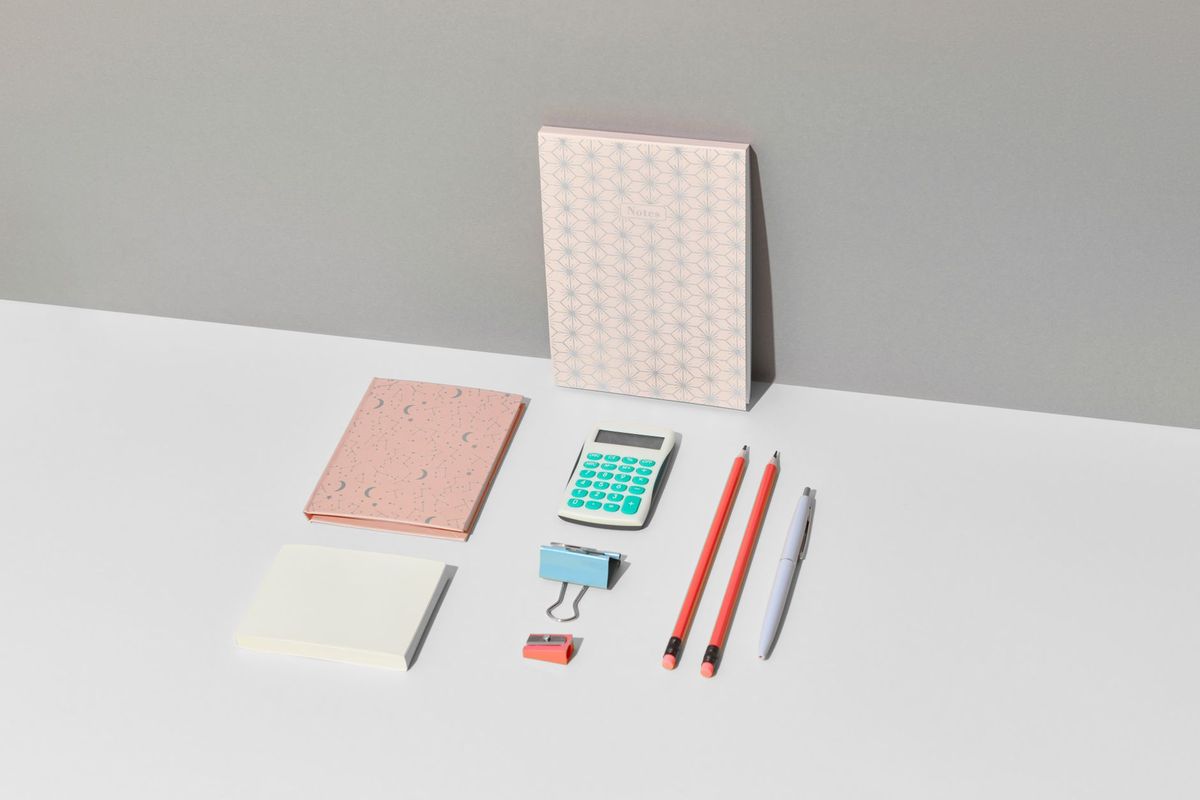
Choosing a notebook is really a decision about constraints. Size decides whether you carry it, whether it opens flat on the table you happen to be sitting at, and how much of a page you get to think on. A4 and A5 are the two formats most people end up weighing against each other, and the gap between them is wider than a couple of centimetres suggests.
Here is what actually changes when you move from one to the other, and how to settle the question without buying three more notebooks to test the theory.
The two formats, plainly
A4 measures 210 × 297 mm, the same as a standard sheet of printer paper. A5 measures 148 × 210 mm, which is A4 folded once: identical proportions, half the area. Because the aspect ratio is the same, layouts tend to scale. A Cornell page, a two-column grid or a weekly spread that works on A4 will usually work on A5, just with less room for long sentences and sprawling arrows.
So the shape is not the issue. The question is how much page you need, and how much room you have to use it in.
Portability: where the notebook actually lives
A5: the one that comes with you
An A5 notebook fits a coat pocket, the front compartment of a rucksack, a handbag, a glovebox. You can hold it open in one hand and write with the other while standing on a platform. That matters more than it sounds. The best notebook is the one that is present when the thought arrives, and A5 is the largest size that still behaves like something you own rather than something you pack.
A4: the one that stays put
A4 needs a bag with a laptop sleeve, a document wallet or a dedicated pocket. It bends at the corners unless it has a hard cover. On a busy train or a standing desk, it is awkward to the point of unusable. In exchange, it never leaves you short of space.
Desk space and the open-page problem
Manufacturers quote closed dimensions; the space you actually need is the open spread. An A4 notebook lying flat occupies roughly 42 × 30 cm. That is most of a small café table, and it will not fit on an aeroplane tray table alongside a drink. An A5 open spread takes about 30 × 21 cm, which leaves room for a mug, a phone and a plate.
If you work at a fixed desk with a large surface, this is irrelevant. If you take notes in meeting rooms, lecture halls, cafés, trains or shared kitchens, it is the deciding factor. Try opening your current notebook on the surface where you do most of your writing. If it overlaps the keyboard, you have your answer.
Page structure: what each size is good at
Where A4 earns its keep
- Meeting notes with a wide left margin for actions and a right column for follow-ups.
- Mind maps, timelines and diagrams that grow outward without hitting the edge.
- Tables of figures, budgets and comparison grids that need columns.
- Taping in handouts, printed agendas or receipts without folding them first.
- Technical work: sketching, calculations, annotated diagrams.
A4 suits the kind of note-taking where the page is a workspace. You are not just recording; you are arranging.
Where A5 wins
- One idea or one task list per page, which keeps entries easy to find later.
- Daily logs and bullet-style journals, where a page per day is a natural rhythm.
- Travel journals and reading notes, which are usually short and sequential.
- Any notebook you intend to carry every single day.
A5 encourages brevity. That is a genuine benefit if your notes tend to sprawl and a frustration if you like to keep everything about a project on one continuous surface.
Handwriting, ruling and lines per page
The ruling matters as much as the paper size. If your handwriting is large, an A5 page ruled at 6 mm will feel cramped and you will write fewer, messier words per page. An 8 mm ruling on the same page is far more comfortable. If your writing is small and neat, dense 6 mm lines on A4 give you a remarkable amount of room.
For anything involving diagrams, dot grid is the most flexible choice: it guides alignment without forcing your text into rows. Plain paper gives you freedom but no structure for straight lists. Ruled paper is best for pure prose and lists.
The practical test: write a paragraph in your normal hand on the ruling you are considering, then count how many lines it filled. If a single idea takes most of an A5 page, you will spend your week flipping pages.
Matching size to your week
- Commuter, student or conference-goer: A5, ideally with a hard cover and a ribbon marker. Carry it everywhere and accept the tighter pages.
- Desk-based planner or project lead: A4, hardback or wirebound so it opens flat. Keep it on the desk and use the margins properly.
- Bullet journal or daily log: A5. One page per day is a well-established rhythm and the format is easy to replace.
- Designer, engineer or maths-heavy work: A4, dot grid or squared, for the extra working space.
- Split system: A5 for capture on the move, A4 for processing and planning at the desk. Many people end up here, and it works well as long as notes are transferred within a day or two.
A short test before you buy
Carry your current notebook for one week and pay attention to two things: how often you left it behind because it was awkward, and how often you ran out of page mid-thought. The first points to something smaller. The second points to something larger.
Then measure the surface you write on most. If an open A4 would cover your keyboard or hang off the edge, choose A5. If you have room to spare and you frequently sketch or tabulate, choose A4.
Choosing well
Most people are better served by A5 than they expect, simply because a notebook you carry gets used far more than one you admire from a shelf. But if your notes are structured, diagram-heavy or written at a desk that never moves, A4 will save you from cramming important thinking into a corner of the page.
Pick the size that matches your space and your habits, not the one that looks impressive on a shelf. And if you are torn, buy one of each in the cheapest binding you can find, run them both for a fortnight, and let your own handwriting tell you which one to commit to.
Photo: DS stories / Pexels